Customer Service
(903) 234-8922

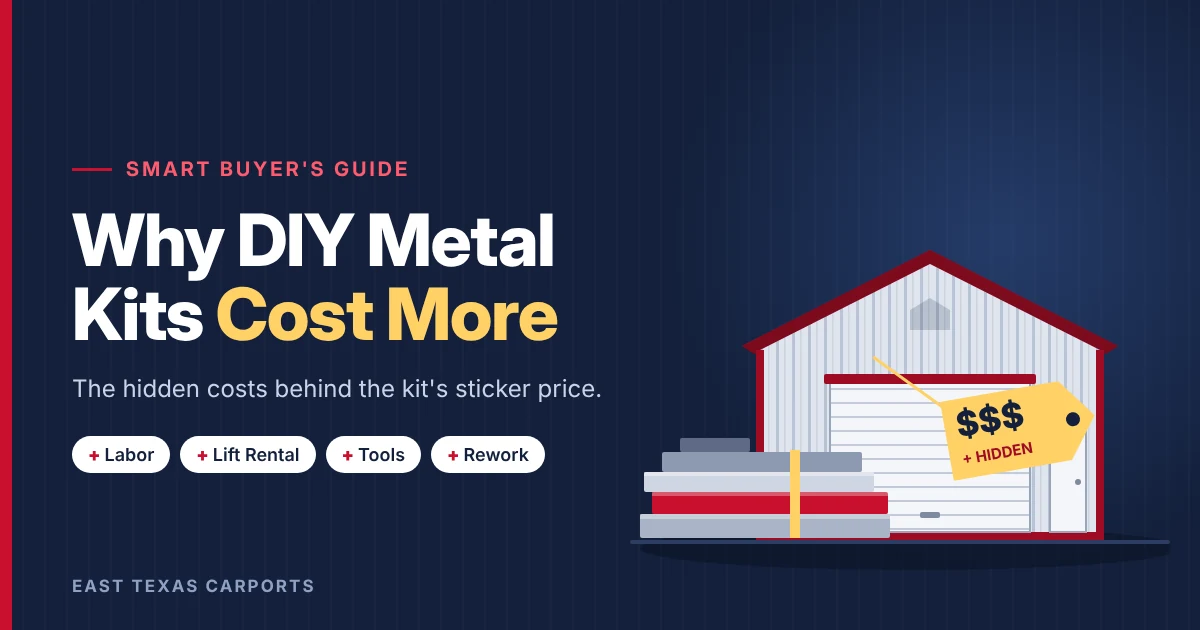
Why DIY Metal Kits Cost More
Published October 28, 2026
A DIY metal kit looks like the budget choice. The price online is often lower than a quote for an installed building. But that number only covers part of the job. Once you add tools, equipment, labor, and risk, a DIY kit often costs more than buyers expect.
This guide breaks down where the extra money goes. It will help you compare a kit and a professionally installed building on equal terms.
What Does a Metal Building Kit Include?
Most kits include the steel frame, roof and wall panels, trim, and fasteners. Some include basic anchors. Doors, windows, and insulation may cost extra.
What a kit does not include is the work. You become the installer, the project manager, and the safety officer. Every hour, tool, and mistake is now your responsibility.
The Hidden Costs of a DIY Metal Kit
1. Labor Is Never Free
Skipping a crew does not remove labor costs. It shifts them to you. A metal building is not a one-person job. Long panels and frame pieces need several sets of hands to lift, square, and fasten safely.
For a sense of what that labor is worth, HomeAdvisor’s metal kit cost guide puts professional assembly at about $5 to $10 per square foot. On a 24×30 garage, that is roughly $3,600 to $7,200 in labor value. If you build it yourself, you pay in weekends, helpers, and lost time instead.
2. Equipment Rental Adds Up Fast
Roof work means working at height. Many DIY builders rent a lift to reach trusses and roof panels safely. According to Bob Vila’s rental cost breakdown, a scissor lift typically rents for $175 to $1,027 per day. Delivery and pickup fees can raise that total.
Weather delays make it worse. A lift sitting idle through a rainy week still costs money. Professional crews bring their own equipment, so you never pay a rental bill.
3. Tools You May Not Own
A proper install calls for more than a drill and a ladder. Common needs include:
- Impact drivers and magnetic driver bits
- Metal-cutting tools for panels and trim
- A long level, chalk lines, and tape measures
- Anchor installation tools suited to your base
- Harnesses, gloves, and eye protection
Buying these for a single project can add hundreds of dollars before the first panel goes up.
4. Mistakes Cost Real Money
Steel is unforgiving. A frame that is out of square will not line up with the panels. A panel cut too short cannot be stretched. A misdrilled hole can let water in for years.
Each error means ordering parts, waiting on shipping, and redoing work. First-time builders also lose time reading manuals and correcting steps. An experienced crew has already learned those lessons on hundreds of jobs.
5. Site Prep and Anchoring Still Matter
A kit is only as strong as its foundation and anchors. The ground must be level. The building must be tied down for the soil or surface it sits on. Our site prep guide explains why a level base is the first step to a lasting building.
Anchors deserve close attention. Concrete, asphalt, and dirt each need a different anchor type. Rebar anchors offer basic support, but they do not meet wind warranty requirements. Our building anchors guide compares each option. Choosing the wrong one can leave a DIY building exposed to the high winds common across the South.
Safety Is the Biggest Hidden Cost
Some costs are not measured in dollars. Falls are the leading cause of death in construction. In a 2024 OSHA news release, the agency cited Bureau of Labor Statistics data showing 1,069 construction worker deaths in 2022. Of those, 395 came from falls from elevation.
Those numbers involve trained workers. Homeowners on ladders and roofs face the same hazards with less experience. The Texas Department of Insurance notes that OSHA requires fall protection whenever a construction worker is 6 feet or more above the ground. Many carport and garage roofs sit well above that height.
An injury can bring medical bills, missed work, and an unfinished building. That risk rarely shows up in the price of a kit.
Warranty and Wind Coverage Questions
Warranty terms vary by manufacturer. Some depend on proper installation and approved anchoring. Before you buy a kit, ask a few direct questions:
- Does the warranty cover a building you assemble yourself?
- Which anchors are required for wind coverage?
- Who pays if a part fails because of an install error?
With a professionally installed building, the same company builds and installs the structure. That keeps responsibility in one place. Review our warranty details to see what is covered on every building we install.
DIY Kit vs. Professional Installation at a Glance
Cost comparison: DIY metal kit vs. professionally installed building
How East Texas Carports Removes the Hidden Costs
East Texas Carports manufactures and installs every building with our own crews. We do not use subcontractors. Delivery and installation are free across Texas, Oklahoma, Arkansas, Louisiana, Mississippi, and Kansas.
Most installs are finished in one day. Every building is custom-sized to your property, not pulled from a generic kit. Frames carry a 10-year warranty, and Sherwin-Williams coated panels carry a 20-year limited paint warranty.
That means no lift rental, no tool shopping, and no weekends on a ladder. If the upfront cost is the concern, our rent-to-own financing spreads payments out without a traditional bank loan.
Is a DIY Kit Ever the Right Choice?
A kit can make sense for some buyers. It may fit someone who already owns the tools, has building experience, and has a reliable crew of helpers. Small, simple structures are also easier to tackle alone.
For most homeowners, though, the math changes once every cost is counted. When the price includes delivery, installation, and anchoring, an installed building often closes much of the gap. It also arrives built right the first time.
Frequently Asked Questions
Is it cheaper to build a metal building kit yourself?
The kit price is usually lower. The total cost often is not. Equipment rental, tools, helpers, rework, and safety risk can erase the savings.
How long does it take to assemble a metal building kit?
It depends on size, experience, and weather. First-time builders often need several days or weekends. A professional crew can finish many carports and garages in a single day.
Do I need special equipment to install a metal kit?
Most projects need power tools, metal-cutting tools, and safe access to the roof. Many builders rent a lift for roof work, which adds daily rental fees.
What is the biggest risk of a DIY metal building?
Falls are the top risk. Federal data shows falls from elevation are the leading cause of construction deaths. Improper anchoring is another risk, especially in high-wind areas.
Get the Full Price Up Front
The cheapest number is not always the lowest cost. Compare kits and installed buildings using the total price, not just the sticker. Ready to see what a custom building costs with delivery and installation included? Request your free quote today.
RECENT ARTICLES
October 28, 2026
Why DIY Metal Kits Cost More
A DIY metal kit looks like the budget choice. The price online is often lower than a quote for an…
Read Full Article
October 22, 2026
Stop Condensation in Your Metal Building
Water dripping from the ceiling of a metal building is not always a leak. In many cases, it is condensation.…
Read Full Article
October 15, 2026
Lock In Steel Building Prices Before They Rise
When you’re planning a carport, garage, or barn, the price on your quote seems like the most stable part of…
Read Full Article
October 9, 2026
Metal Building vs. Stick-Built Garage: Cost and Durability Compared
Metal Building vs. Stick-Built Garage: Cost and Durability Compared Adding a garage is one of the most practical upgrades a…
Read Full Article